Julia Roberts - Won her Suit for Freedom (written by Zachary Newark)
On May 20, 1842, a jury of twelve men in Alexandria County, Virginia decided that one enslaved woman was illegally a slave. With the words “We of the Jury find for the Petitioner,” Julia Roberts became a free woman.
Julia’s freedom suit began long before she was born. A wealthy Revolutionary War veteran named Simon Summers purchased her mother, Sarah, in 1785. Summers owned land in present-day Arlington and Fairfax Counties. His house was likely somewhere a little south of Langston Boulevard and west of North Harrison Street, according to later probate documents.
Summers, in a phase of Methodist magnanimity, drafted a deed of manumission on December 31, 1801, and declared the slavery was “contrary to the spirit of Christianity or humanity.” It said Sarah was to be free in 1814 and any of her children freed at 25. On February 18, 1802, Summers traveled to the courthouse in Fairfax, Virginia, as he had done for years, to record and make the deed official. This time, however, Summers crossed a new boundary—the border between Virginia and the new federal District of Columbia, which Congress had created less than a year before. Under controlling law, Summers could only record a deed in the courthouse in the county “where he or she resides.” Because Summers no longer lived in Fairfax County, he should have gone to the Alexandria courthouse. This technicality threatened the validity of the manumission deed—and the future freedom of several enslaved people.
Sarah had as many as 14 children. Julia was among them, apparently born on April 23, 1812. When she was not quite six years old, Julia’s enslaver, Summers’s son-in-law, Wesley Adams, sold her for a term of years. A newspaper advertisement declared how “Valuable & likely Negroes” were to be sold at the Adams’ farm.
A farmer named George Crump purchased young Julia for a term that was to end in twenty years. For decades, she toiled as the sole enslaved person on this small farm, performing tasks both indoors and on Crump’s twenty acres.
The day of her emancipation came and went. Rather than go free, Julia was placed into Wesley Adams’ daughter’s possession. While she was still working for Crump, Wesley Adams sold Julia to his son, Austin Adams, for a nominal $5. In the deed of sale, he described Julia as “a slave to me for life.” Now, Julia was stuck on Austin Adams’s sister, Ann Harding’s, property in present-day day Barcroft, Arlington Forest, and Buckingham neighborhoods.
Besides flee these deeply unfair circumstances, what could she do? Julia used the power of the law to adjudicate her status, claiming she was wrongfully held as a slave because Summers’ deed of manumission entitled her to freedom. She filed a petition and, with the help of two lawyers assigned to her case, developed evidence to support her case. Some of the evidence included testimony from people who knew that Julia’s mother, Sarah, was a freedwoman and that Julia was supposed to be free “when she arrived at a certain age.” Ann Harding and Austin Adams, meanwhile, challenged the deed’s validity because it was recorded in Fairfax rather than Alexandria.
The jury found for Julia. Adams and Harding appealed directly to the U.S. Supreme Court, the appellate court for the federal court covering Alexandria County at the time. Justice James Wayne, writing for a unanimous court, affirmed the verdict in an opinion primarily focused on the jury’s primacy as factfinder. The defendants sought a jury instruction that would have limited the jury’s role by allowing them to only find the deed invalid—a restriction the Court rejected.
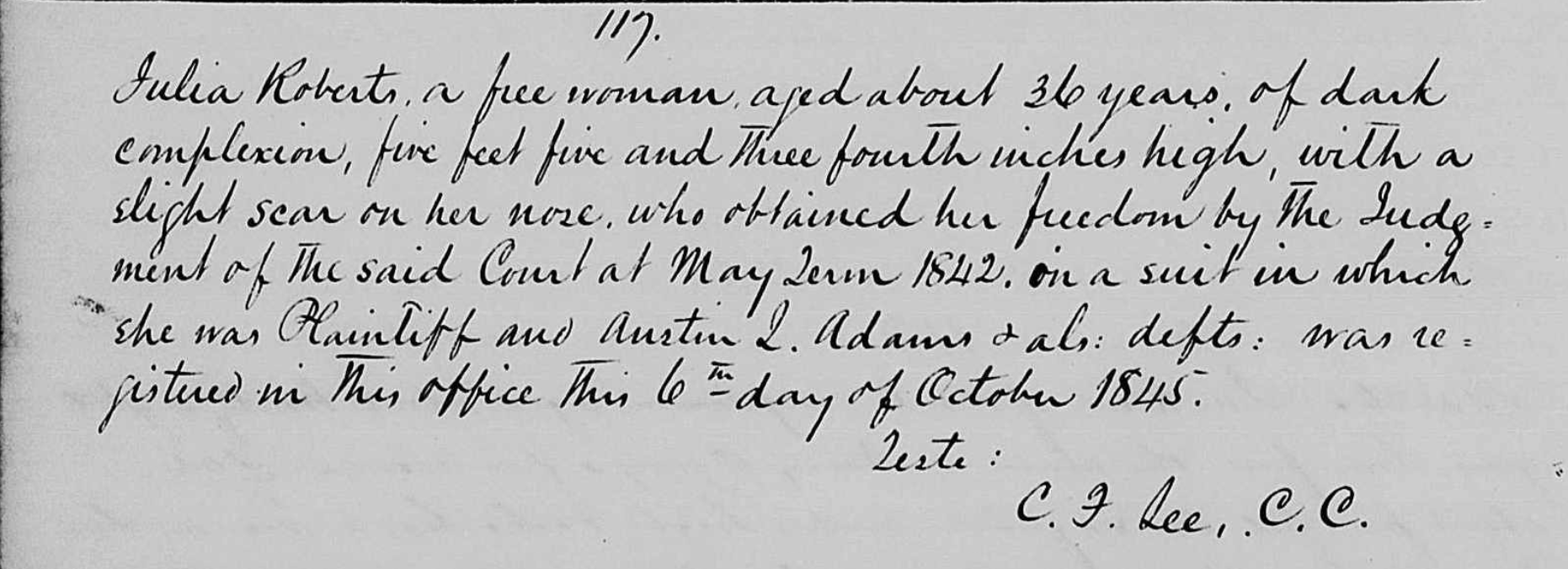
Julia’s freedom suit was only one of six originating in the federal court in Washington, D.C. that was successful before the Supreme Court. In 1845, Julia registered as a freedwoman in Alexandria—“a free woman and about 36 years, of dark complexion, five feet five and three fourth inches high, with a slight scar on her nose, who obtained her freedom” by lawsuit. She appears in the 1860 Census living in Georgetown and the 1870 Census working as a cook, but after that disappears from the pages of history—a freedwoman, nonetheless.